
Free tool
Napoleon's Book of Fate oracle: ask one question
Napoleon's Oraculum is a fortune-telling game printed in cheap booklets for more than a century and said to be Napoleon's. Choose a question, draw four rows of marks, and the old table finds your answer, just as in the book.
1. Choose a question
Keep it in mind before you draw.
2. Draw four rows of marks
Each row is a handful of short strokes. An odd number makes one dot, an even number makes two.
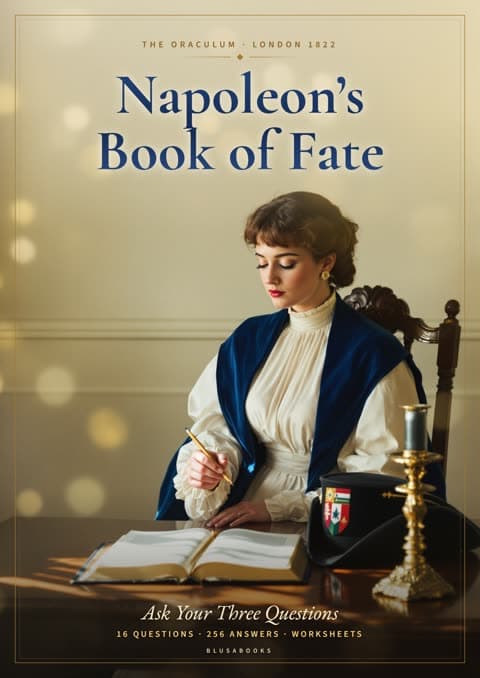
Napoleon's Book of Fate: the whole Oraculum
All 16 questions with their 256 answers, a guided three-question reading, a short history of the legend, and printable worksheets. PDF, 38 pages.
How the Oraculum works
The legend
A London bookseller printed it in 1822 as the Book of Fate, once owned by Napoleon, and told a splendid story of an Egyptian papyrus found in a royal tomb. Historians treat the story as a publisher's legend, and no such papyrus has ever been found. The little oracle itself, with its sixteen questions, lived on in cheap fortune-telling handbooks for a century.
The method
Choosing an answer by odd and even marks, and building a figure of one or two dots in four rows, is geomancy, an art practised in the Arab world and across medieval Europe. Its sixteen figures are exactly the sixteen your four rows can make. The figure and your question meet in a table, the table gives a letter, and the letter names the page where your figure carries your answer.
The text
The answers come from the English text printed in New York in 1902 (How to Tell Fortunes, public domain), in our edition and Latvian translation. Some of them speak with the voice of their time. We left them as they are, apart from those we removed (see the note below).
Questions
What is Napoleon's Book of Fate?
A fortune-telling booklet first printed in London in 1822 and attributed to Napoleon. It uses sixteen questions and a table of marks to point to one of 256 short answers. We present it as a historical text for entertainment.
Did Napoleon really use this oracle?
There is no evidence for it. The story of the Egyptian papyrus appeared in a book printed in London in 1822, after Napoleon's death, and historians regard it as a publisher's legend.
Is the answer random?
Yes. Your marks decide the figure, and the old table does the rest. The same question can give a different answer every time.
Why are some questions missing?
The old oracle also asks about illness, prison, birth, lawsuits, money and marriage. Its answers there speak of death, poverty and wealth, and a free toy is not the place for them. They stay in the book as a historical text.
Can I trust the answer?
No more than a game. It is a piece of cultural history for entertainment and gives no guidance on health, money, law or relationships.