
 1 / 8
Stand-alone guide
The Man in the Moone: The First Voyage to the Moon
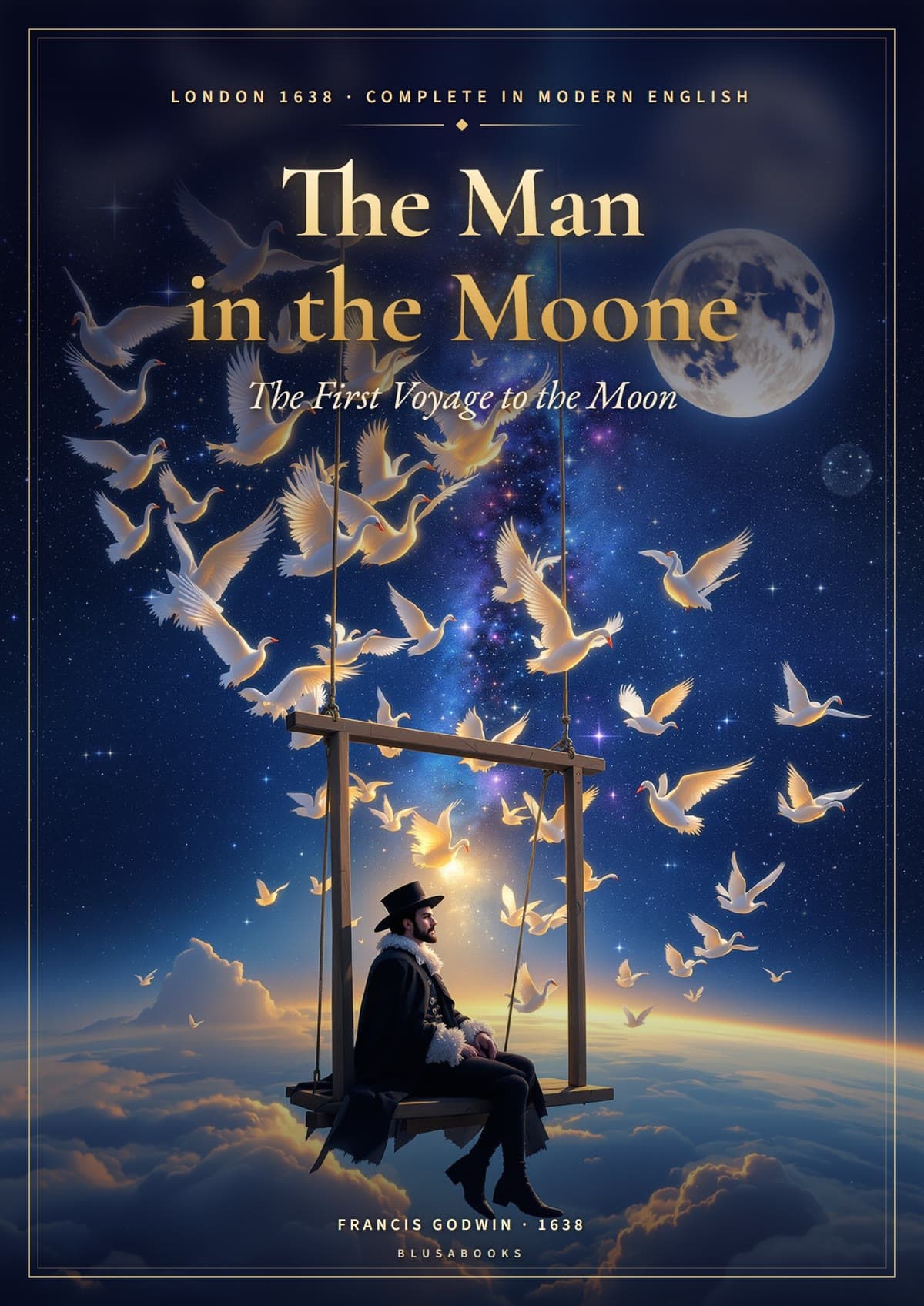
One of the first voyages to the Moon in English: in 1638, five years after its author's death, London readers met Domingo Gonsales, a small and very proud Spanish gentleman who trains a flock of wild swans, builds an Engine they can pull through the air and becomes, in the story, the first flying man. Complete, in modern English, with all the original engravings. PDF, 75 pages.
−50% €8.49 €4.24
Sale ends 9 Dec · Lowest price in the last 30 days: €8.49
PDF e-book · no VAT added · instant download
Read a free sample →- 75 pages, illustrated PDF — reads well on phone, tablet and computer
- Instant download after payment, links also sent by e-mail
- Secure checkout with Stripe — card, Apple Pay and more
About this book
Stranded on the island of St Helena, Gonsales teaches his "gansas" to carry loads. When his ship is caught in a sea fight off Tenerife, the birds save him — and then carry him up past the peak of Teide, above the clouds, into weightlessness and, after twelve days, to the Moon. There he meets gentle giants twice as tall as men who speak in melodies instead of words, a land without crime or sickness, and wonder-stones, one of which takes away a body's weight. He watches the Earth turn beneath him and admits that Copernicus was right. And when at last he flies home, he lands not in Spain but in China.
Francis Godwin (1562–1633), Bishop of Hereford, wrote this tale when Galileo's telescope had just turned the Moon into a world. It is one of the earliest science fiction stories and is thought to have inspired Cyrano de Bergerac's own voyage to the Moon.
Rendered into modern English by BlusaBooks with the help of AI tools, working from images of the pages of the first edition, London 1638. A complete, sentence-by-sentence text, not a summary or a retelling. The original has no chapters; our section headings make it easy to follow.
What is inside
- the whole story in twelve parts, plus the original address "To the Ingenious Reader"
- all the engravings of the 1638 edition, captioned: the famous frontispiece of Gonsales drawn by his gansas, the view of St Helena, the woodcut of the Azores and the printed music of the Lunar language
- eight colour illustrations in the manner of 17th-century painting and engraving (created with AI tools)
- 92 footnotes on the same page: places, people and allusions explained, and what we know today where Godwin's science differs from ours
- a preface: Godwin's life, why the book appeared in 1638, Copernicus, Galileo, Gilbert's magnetism and the story's influence
- Commentary at the end: each part in plain words and what modern science says — bird migration, gravity and weightlessness, the lunar day, the Earth seen from space, the Apollo missions, tonal languages, the Jesuits in China
Who it is for
Readers of classic science fiction, from Kepler and Cyrano to Jules Verne and H. G. Wells; anyone curious about the Moon, space travel and the history of science; a thoughtful gift for an astronomy lover.
A historical source: Godwin writes as a man of the early seventeenth century, with the knowledge and beliefs of his time. The notes and commentary explain what we know today.
Reader reviews
No reviews for this book yet. Every buyer is invited to leave an honest review a week after purchase — reviews come only from verified buyers.